Track this checklist in your personal plan.
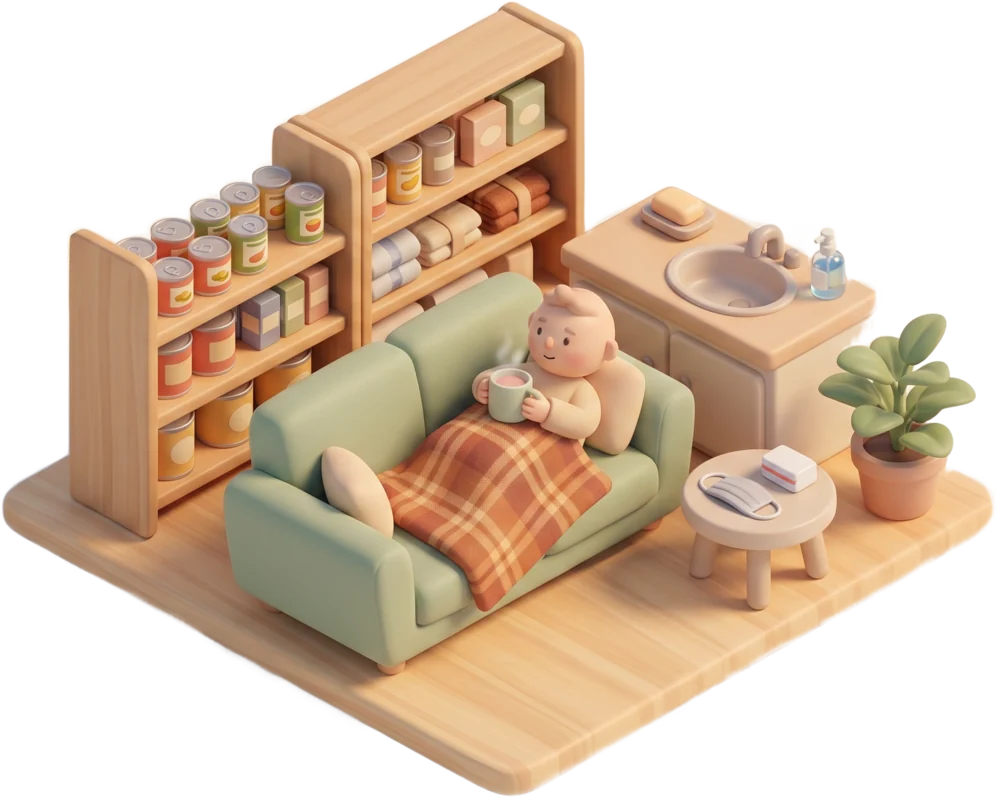
Pandemic / infectious disease
Stay informed, protect yourself and others, and be ready to isolate calmly at home.
Official maps and warning channels for Germany
Whether your street is affected is answered only by the official maps for your area.
Open NINA (Germany)A pandemic is a widespread outbreak of an infectious disease that spreads across many countries. Most people can protect themselves and others with simple, proven steps: good hygiene, fresh air, staying home when ill, and following official health advice. Not every outbreak is severe, and guidance will change as authorities learn more — so the most important habit is to keep checking reliable sources. A little preparation makes a big difference. If you can look after yourself at home for one to two weeks, you reduce your own risk, ease pressure on health services, and help slow the spread. This page gives calm, general advice; always follow the specific instructions of your national and local health authority.
When it is happening
Only if this scenario is imminent or already underway — not everyday preparation. For prep ahead of time, see How to prepare and the checklist below.
When an outbreak is announced
- 1Follow the official guidance of your national and local health authority.
- 2Get information only from trusted sources such as the Robert Koch Institute (RKI), the health ministries, the ECDC, or the WHO.
- 3Wash your hands often with soap and water for at least 20 seconds.
- 4Ventilate rooms regularly by opening windows wide for a few minutes.
- 5Keep your distance from people who are clearly ill.
- 6Check on vulnerable family, friends, and neighbours by phone or message.
If you or someone at home feels ill
- 1Stay home and limit contact with others in the household.
- 2Phone your doctor or the out-of-hours medical service on 116117 before going in person.
- 3Rest, drink fluids, and follow the treatment advice you are given.
- 4Cover coughs and sneezes with a tissue or your elbow.
- 5Wear a face mask if advised, especially around others.
- 6Clean shared surfaces, door handles, and bathrooms more often.
In a medical emergency
- 1Call 112, the EU-wide emergency number, for severe breathing problems, chest pain, or collapse.
- 2Tell the operator about symptoms and any known infection.
- 3Follow their instructions while you wait for help.
Important safety warnings
- In a life-threatening emergency — severe breathing difficulty, chest pain, or unconsciousness — always call 112.
- Do not take prescription medicines, antibiotics, or antivirals that were not prescribed to you; misuse can be dangerous and antibiotics do not work against viruses.
- Do not go to a doctor's office, pharmacy, or hospital unannounced if you may be infectious — phone first so staff can protect others.
- Do not rely on rumours, social media claims, or unverified 'cures'; follow only official health authorities.
- Do not visit or expose vulnerable people (elderly, pregnant, chronically ill) if you have symptoms.
- Do not panic-buy or hoard medicines and supplies — this leaves others, including the sick, without what they need.
How to prepare
Build a modest home supply
- 1Store enough food and drinking water to stay home for one to two weeks.
- 2Choose items that keep well and that your household actually eats.
- 3Keep supplies for any pets in the home.
- 4Restock gradually rather than panic-buying.
Stock hygiene and medical items
- 1Keep soap, hand sanitiser, tissues, and cleaning products at home.
- 2Store a few face masks for when they are advised.
- 3Keep a well-filled first-aid kit and a working thermometer.
- 4Hold a small buffer of any regular prescription medicines, and ask your doctor about repeat prescriptions.
- 5Keep basic remedies such as fever reducers and pain relief.
Plan for care and daily life
- 1Agree who would care for children or dependent relatives if someone falls ill.
- 2Note down important phone numbers: doctor, pharmacy, out-of-hours medical service (116117).
- 3Ask about working or studying from home if that becomes necessary.
- 4Set up a way to receive official alerts, such as a warning app.
Good to know
- Official guidance during a pandemic changes as more is learned — recheck trusted sources regularly instead of acting on old information.
- The Robert Koch Institute (RKI), the EU's ECDC (European Centre for Disease Prevention and Control) and the WHO publish reliable, non-political health updates for the public.
- In Germany emergency information arrives via cell broadcast ("DE-Alert") and the warning apps NINA and KATWARN.
- Simple measures work: handwashing, ventilation, distance, and staying home when ill are among the most effective ways to slow spread.
- Vaccination, where offered and recommended by health authorities, is one of the strongest protections for you and vulnerable people around you.
Preparedness checklist
The concrete steps for this scenario. Add them to a plan to track your progress.
Actions
- Stay home and isolate if you have symptomsEssential
Staying put at the first symptoms is one of the most effective ways to break infection chains, and every case prevented eases pressure on health services. Remain home until clearly recovered, keep distance from housemates where you can, and follow your health authority's current isolation advice for that outbreak.
- Wash hands often and ventilate rooms regularlyEssential
Twenty to thirty seconds with plain soap removes most pathogens from your hands — wash after coming home, before eating, and after coughing or blowing your nose. Air shared rooms several times a day by opening windows wide for a few minutes; fresh air dilutes virus-carrying aerosols indoors.
- Protect and check on vulnerable peopleEssential
Elderly, pregnant and chronically ill people face the highest risk of severe illness, so stay away from them entirely while you have symptoms. Check in regularly by phone or message instead, offer to leave groceries at the door, and wear a well-fitted FFP2 if a visit truly cannot wait.
- Phone your doctor or helpline before going in person
Calling ahead lets the practice protect other patients and staff — often you get advice, a prescription or a separate appointment slot without sitting in a crowded waiting room. Make it your rule whenever you might be infectious; for a genuine emergency such as severe breathing difficulty, call 112 instead.
Supplies
- Store 1-2 weeks of food and drinking waterEssential
During a wave you may need to isolate at home for a week or more, so shelf-stable, no-cook basics matter most: canned goods, crispbread, UHT milk, dried fruit, nuts. Plan about 2 litres of water per person per day and rotate the stock through your normal meals so nothing expires uneaten.
- Keep a buffer of regular prescription medicinesEssential
Pharmacies and practices can be overloaded and supply chains disrupted, so official German guidance suggests roughly a 10-day reserve of any regularly taken prescription drug such as asthma spray or insulin. Arrange the extra supply ahead with your doctor or pharmacist, and never adjust doses yourself.
- Stock soap, hand sanitiser, tissues, and cleaning productsEssential
Frequent handwashing empties supplies faster than you expect, so keep enough soap, tissues, toilet paper and household cleaner for one to two weeks. Sanitiser is the on-the-go backup — pick one labelled virucidal, meaning effective against viruses — while plain soap and water stay first choice at home.
- Keep a few face masks at home
A small reserve spares you shopping trips once an outbreak starts. FFP2 respirators (EN 149) seal to the face and filter at least 94% of particles in both directions; medical masks (EN 14683) mainly limit droplets you emit. For your own protection, choose a fitted, valve-free FFP2 over a loose surgical mask.
- Keep a first-aid kit, thermometer, and fever/pain reliefEssential
A digital fever thermometer lets you track an illness objectively and describe it precisely over the phone. Keep a household kit stocked to the DIN 13157 benchmark plus simple fever and pain remedies dosed per their leaflets, stored cool, dry and away from children — not in the bathroom. Check expiry dates yearly.
Skills
- Agree a care plan for children and dependents
Illness rarely gives notice, so agree now who steps in if you are laid up: name a backup carer for children, dependent relatives or pets, and exchange keys and phone numbers. Write down medication schedules, doctors' contacts and daily routines, then walk your stand-in through the plan once so it holds under stress.
Know & check
- Follow only trusted official health sourcesEssential
Rumours and miracle cures spread faster than any virus, and acting on them can be dangerous. Bookmark the Robert Koch Institute (RKI) now, alongside the EU's ECDC and the WHO, and recheck them during an outbreak — guidance legitimately changes as more is learned, so old advice can be wrong advice.
- Install an official alert app (e.g. NINA)
Germany warns by cell broadcast ("DE-Alert"), which needs no app and works on most modern phones. A warning app adds detail and regional health notices — NINA or KATWARN. Check in your phone's notification or safety settings that emergency alerts are enabled.
Official sources
- Federal Office of Civil Protection and Disaster Assistance (BBK) · BBK (Germany)
- EU Civil Protection & Humanitarian Aid · European Commission
- Infection protection – current guidance · Robert Koch-Institut (RKI)
- European Centre for Disease Prevention and Control · ECDC
- World Health Organization · WHO
- International Federation of Red Cross and Red Crescent Societies · IFRC
Official sources in Germany
Content last reviewed: September 4, 2026