Track this checklist in your personal plan.
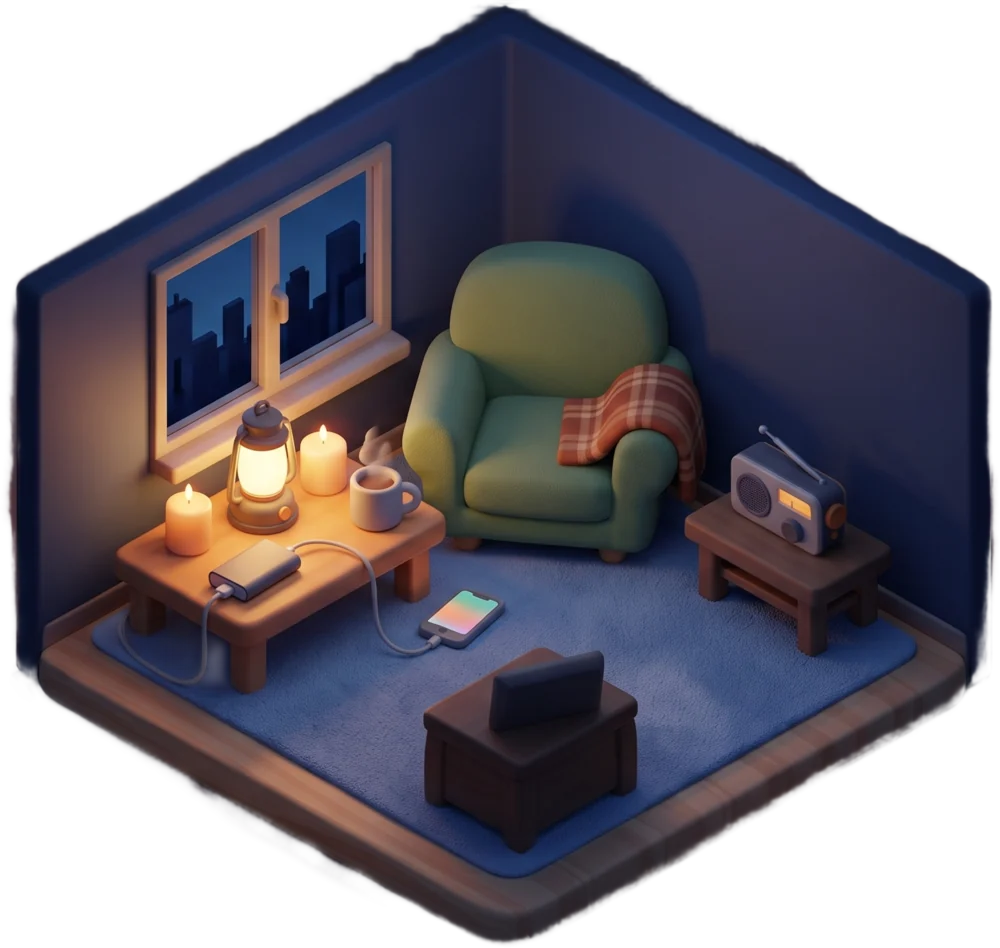
Power outage / blackout
Stay warm, informed, and safe when the electricity stops — from a short cut to a multi-day blackout.
Official maps and warning channels for Germany
Whether your street is affected is answered only by the official maps for your area.
Open NINA (Germany)A power outage can last a few minutes or, in rare cases, several days across a whole region. Most outages are short and end on their own. The main risks come from the things we normally rely on: light, heating, cooking, fridges, water pumps, lifts, card payments, and mobile networks. A little planning makes even a long blackout manageable and much less stressful. This guide explains what to do during an outage and how to prepare in advance, based on official public guidance from Germany's BBK, EU Civil Protection, WHO and the Red Cross/Red Crescent (IFRC). In any life-threatening emergency, call 112, the EU-wide emergency number — it works from any mobile phone, even without credit or signal from your own network.
When it is happening
Only if this scenario is imminent or already underway — not everyday preparation. For prep ahead of time, see How to prepare and the checklist below.
First minutes
- 1Stay calm — most outages are short and end by themselves.
- 2Check if only your home is affected: is a fuse tripped, or are the neighbours and street lights dark too?
- 3If it is just your home, check your fuse box / circuit breaker and reset if safe.
- 4Use a torch or lantern for light — avoid candles and open flames if possible.
- 5Switch off or unplug ovens, irons, heaters and sensitive electronics to protect them from a power surge when electricity returns.
- 6Leave one light switch on so you know the moment power comes back.
Get information
- 1Turn on a battery or hand-crank radio and tune to your local or public station for official updates.
- 2Check your phone for a cell broadcast (DE-Alert) warning or a warning-app message, but keep phone use short to save battery.
- 3Do not call 112 or the power company just to ask when power returns — keep emergency lines free.
- 4Note the time the outage started; it helps you judge food safety later.
Keep food, water and warmth
- 1Keep the fridge and freezer doors closed — a freezer stays cold for about 24–48 hours depending on how full it is, a fridge for a few hours.
- 2Eat fresh and chilled food first, then frozen, then your stored non-perishable supplies.
- 3If it is cold, close doors and curtains, gather in one room, and wear layers, hats and blankets to hold heat.
- 4Fill bottles, pots and the bathtub with water early, in case pumps stop working.
- 5If the outage looks long, top up phones from a charged power bank or your car (engine running outdoors only).
- 6Check on neighbours who are elderly, ill, alone or dependent on electric medical equipment.
Important safety warnings
- Never run a generator, petrol/gas grill, camping stove or charcoal indoors, in a garage, or near open windows — they release carbon monoxide, an invisible, odourless gas that can kill within minutes.
- Never use gas cookers, patio heaters or an oven to heat a room — this also causes deadly carbon monoxide build-up.
- Keep candles and open flames away from anything flammable, never leave them unattended, and keep them well clear of gas — use torches instead where you can.
- Do not open the freezer or fridge more than necessary; refreeze thawed food only if it still contains ice crystals, and when in doubt, throw it out.
- Do not use lifts during an outage — you could be trapped when power fails or returns.
- In any life-threatening emergency — fire, a medical crisis, someone unconscious — call 112 immediately.
How to prepare
Light and power
- 1Keep torches or LED lanterns and spare batteries in a place you can find in the dark.
- 2Buy at least one charged power bank per person for mobile phones.
- 3Keep a battery-powered or hand-crank radio so you can receive information without mains power.
- 4A car USB charger or a small solar charger is a useful backup for phones.
Warmth, food and water
- 1Store food that needs no cooking or refrigeration for several days (tinned food, muesli bars, crackers, nuts, dried fruit).
- 2Keep drinking water in reserve — the guideline is about 2 litres per person per day for several days.
- 3Have a plan to stay warm without electric heating: warm clothing, blankets, sleeping bags, and one room you can keep warm.
- 4Keep a manual tin opener, and think about a safe way to prepare warm food or drinks (e.g. a camping stove used outdoors only — never indoors, because of carbon monoxide).
Money and documents
- 1Keep some cash in small notes and coins — card machines and cash points do not work without power.
- 2Keep copies of important documents and emergency phone numbers on paper, not only on your phone.
- 3Note that fixed phones, door intercoms, lifts and electric garage doors may stop working.
People and information
- 1Agree a family meeting point and a contact plan in case mobile networks fail.
- 2Install the official warning app NINA and enable cell broadcast ("DE-Alert") / emergency alerts on your phone.
- 3Download offline maps for your home and work area in advance — phone map apps go blank when mobile data fails.
- 4Know who near you may need help: neighbours who are older, ill, alone, or rely on electric medical devices.
Good to know
- 112 is the free emergency number across the whole EU and works from any mobile phone, even with no credit and even on another network.
- Mobile phone networks have limited battery backup — during a long blackout they may stop working, so save your phone battery and keep messages short.
- A full freezer holds the cold much longer than a half-empty one; filling gaps with bottles of water helps food last longer.
- Cell broadcast ("DE-Alert") can send urgent warnings straight to phones in an affected area; in Germany the NINA warning app complements it.
- Cordless landline phones and internet routers need mains power — a simple corded phone or a charged mobile is more reliable in an outage.
- Carbon monoxide has no colour and no smell; a battery carbon-monoxide alarm is a cheap, life-saving early warning.
Preparedness checklist
The concrete steps for this scenario. Add them to a plan to track your progress.
Actions
- Keep fridge and freezer doors closed to hold the cold
An unopened fridge holds a safe temperature for a few hours, a full freezer for a day or two - every opening costs cold, so decide what you need before touching the door. Filling freezer gaps with water bottles adds cold reserve. Afterwards, refreeze only food that still has ice crystals; when in doubt, throw it out.
- Check on vulnerable neighbours during an outage
Doorbells, lifts, phones and powered medical devices such as oxygen concentrators can all fail, leaving older or ill neighbours cut off. Knock in person early in an outage and at least daily if it lasts, and help organise support for anyone who depends on powered equipment - in an emergency, call 112.
Supplies
- Keep torches / LED lanterns and spare batteries readyEssential
LED lights run far longer per battery set than old bulb types; a headlamp per person keeps your hands free, plus a lantern-style light for the room. Standardise on one battery size (AA or AAA), store spares outside the devices, and prefer battery light to candles. Around 100-300 lumens is plenty for moving about.
- Keep a charged power bank for each phoneEssential
After conversion losses, a 10,000 mAh bank gives roughly 1.5 full phone charges and a 20,000 mAh model about 3 - size yours accordingly. Choose USB-C with Power Delivery so one bank charges all your devices, and top it up every 3-6 months, because stored lithium cells slowly self-discharge.
- Store a battery or hand-crank radioEssential
When mobile networks and internet fail with the power, broadcast transmitters keep running, so radio stays the most reliable news channel. Pick a dual FM and DAB+ tuner, ideally battery-powered with a crank or solar backup, and keep spare batteries outside the device. Your car radio works in a blackout too.
- Store about 2 litres of drinking water per person per dayEssential
In a longer blackout, pumping stations can stop and taps may run dry, especially on upper floors. Plan roughly 1.5 L drinking plus 0.5 L cooking water per person per day, covering at least 72 hours. Keep sealed bottled water cool and dark; refill self-filled food-grade containers about every six months.
- Stock several days of food that needs no cooking or coolingEssential
Cookers, fridges and freezers all stop, so build your stock around food that is fine cold: canned fish and vegetables, crispbread, nuts, dried fruit, UHT milk. Cover at least 72 hours - official German guidance suggests up to ten days. Store what you normally eat, rotate before expiry, and add a manual can opener.
- Keep some cash in small notes and coinsEssential
Card terminals and ATMs stop with the power, so shops that stay open may accept cash only. Several national authorities suggest roughly 70-100 euros per person - about 72 hours' worth - in small notes plus coins, since change may be scarce. Store it dry, in a fixed spot known only to trusted household members.
- Prepare blankets and warm clothing to stay warm without heatingEssential
Most heating systems, including gas and oil boilers, need electricity for pumps and controls, so your home cools fast in winter. Layer wool or fleece, add hats and socks, and gather everyone in one small room to hold the warmth. Never heat with a gas cooker, grill or patio heater indoors - carbon monoxide kills.
- Fit a battery carbon-monoxide alarm
CO poisonings spike in outages when generators, grills or camping stoves come indoors - never do that; they belong outside only. Pick an EN 50291-certified alarm for any room with a fuel-burning appliance plus sleeping areas, and replace it by its marked end-of-life date - sensors last about 7-10 years.
Skills
- Agree a family meeting point and contact plan
Phone batteries and mobile networks can die mid-outage, so agree in advance where your household meets and who your out-of-area contact is. Sit down together, write the plan and key numbers on paper for every wallet and school bag, and refresh it yearly. Short texts get through congested networks better than calls.
Know & check
- Install a warning app and enable cell broadcast (DE-Alert) on your phoneEssential
Germany warns by cell broadcast ("DE-Alert"), which needs no app or sign-up. Enable emergency alerts in your phone's settings and add a warning app - NINA or KATWARN. Networks can fail in a long blackout, so your radio remains the backup.
- Remember 112 for any life-threatening emergencyEssential
Across the EU, 112 is free and works from any mobile phone, even without credit, over any network that still has coverage. Reserve it for life-threatening emergencies - fire, a medical crisis - not questions about the outage, so lines stay open. If networks go down, get help in person at an emergency meeting point or civil-protection "lighthouse" (Katastrophenschutz-Leuchtturm) of your municipality, or at a staffed fire station.
Official sources
- Federal Office of Civil Protection and Disaster Assistance (BBK) · BBK (Germany)
- EU Civil Protection & Humanitarian Aid · European Commission
- International Federation of Red Cross and Red Crescent Societies · IFRC
- World Health Organization · WHO
- 112 — the European emergency number · European Commission
Official sources in Germany
Content last reviewed: September 4, 2026