Track this checklist in your personal plan.
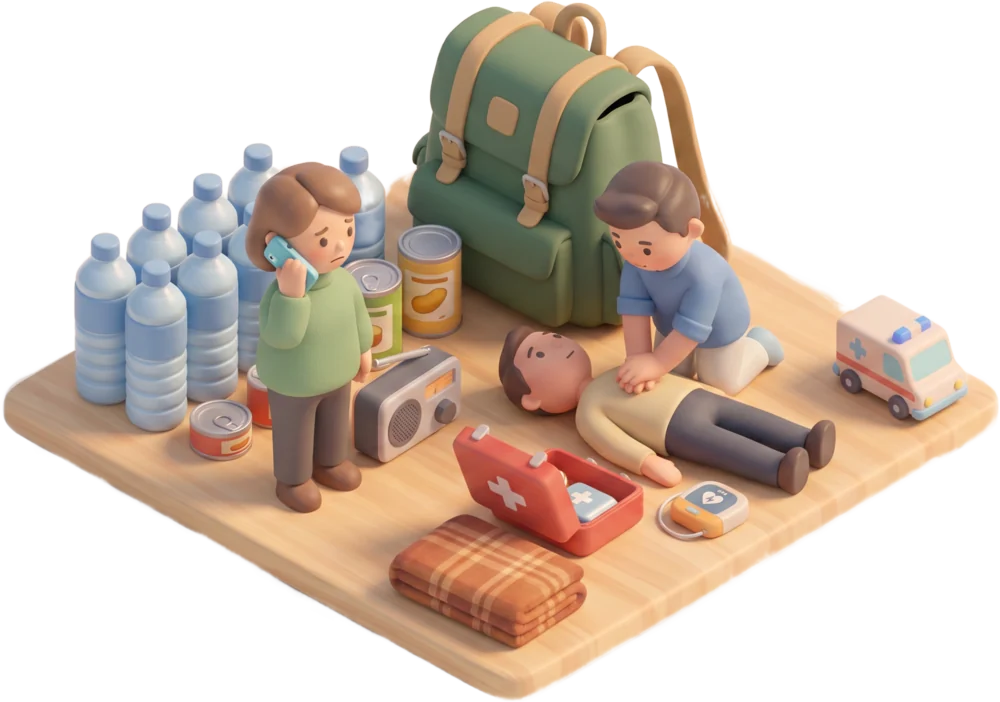
Medical emergency
Recognise a life-threatening emergency, call 112, and give first aid until help arrives.
Official maps and warning channels for Germany
Whether your street is affected is answered only by the official maps for your area.
Open NINA (Germany)Everyday medical emergencies — a collapse, severe bleeding, choking, a stroke, or a serious allergic reaction — can happen anywhere. Simple, calm first aid in the first minutes can save a life, and you do not need to be a professional to help. The most important step is always the same: call 112, the free EU-wide emergency number, and follow the instructions of the dispatcher. This page gives general information to help you recognise and act, based on mainstream official guidance (BBK, Red Cross/IFRC, WHO). It is not medical advice and does not replace a first-aid course or professional care. In any life-threatening situation, call 112 first.
When it is happening
Only if this scenario is imminent or already underway — not everyday preparation. For prep ahead of time, see How to prepare and the checklist below.
First: make it safe and call 112
- 1Check for danger to you and the person before you approach (traffic, fire, electricity).
- 2Try to wake the person: speak loudly and gently shake their shoulders.
- 3If there is no normal response, shout for help and ask a bystander to call 112.
- 4If you are alone, call 112 yourself and put the phone on speaker.
- 5Tell the dispatcher where you are, what happened, and how many people are hurt. Do not hang up.
- 6Ask a bystander to fetch an AED (defibrillator) if one is nearby.
Let the dispatcher guide you
- 1Stay on the line — the 112 dispatcher tells you step by step what to do until the ambulance arrives.
- 2Modern dispatch centres talk untrained helpers through first aid over the phone, including chest compressions if they are needed.
- 3If a public AED (defibrillator) is nearby, the dispatcher may ask someone to fetch it — AEDs speak their instructions aloud and are designed for untrained helpers.
- 4If you have done a first-aid course, apply what you practised — and never delay calling 112 to look something up.
While help is on the way
- 1Stay with the person and keep talking to them calmly, even if they do not respond.
- 2Do not move a seriously injured person unless they are in immediate danger.
- 3Keep the person warm, and note when the symptoms started — the ambulance crew will ask.
- 4Send someone to open doors, clear the way and wave the ambulance down.
Important safety warnings
- In any life-threatening situation, call 112 first — never delay giving or getting help.
- Never leave a collapsed, non-responsive person alone if you can call for help while staying with them.
- Do not hang up — stay on the line and follow the dispatcher's instructions until help has arrived.
- Never give food, drink or medicine to an unconscious or drowsy person — it can block their airway.
- Do not move a seriously injured person unless they are in immediate danger (fire, traffic, water).
- Never put yourself in danger to help — you cannot rescue anyone if you become a casualty too.
How to prepare
Learn the skills
- 1Take a hands-on first-aid course and refresh it every 2–3 years.
- 2Learn hands-only CPR and how to use an AED (defibrillator).
- 3Practise the recovery position and the FAST stroke check.
- 4Teach basic first aid and the number 112 to everyone in your household, including children.
Equip your home and bag
- 1Keep a complete, in-date first-aid kit at home and a small one in the car.
- 2Check the kit once a year and replace anything used or expired.
- 3Keep prescribed medicines stocked, and carry emergency medicines (e.g. adrenaline auto-injector, asthma inhaler) with you.
- 4Know where the nearest public AED is at work and in places you visit often.
Keep medical information ready
- 1Write down your allergies, conditions, medicines and doses, and keep a copy at home and in your wallet.
- 2Set up an emergency contact and a medical ID on your phone's lock screen.
- 3Note the details of children, older relatives or anyone you care for.
- 4Make sure others can reach this information quickly in an emergency.
Good to know
- 112 is free in Germany and across the EU, works without credit and over any available network. Without a SIM card an emergency call is not possible in Germany – the card must be in the phone.
- You can call 112 in many countries in English if you do not speak the local language — the dispatcher can guide you.
- First-aid courses with recognised aid organisations take only a few hours and are offered all over Europe — they are the best preparation; refresh every 2–3 years.
- AEDs are designed for the public: they give spoken step-by-step instructions and will not shock unless a shock is needed.
- In Germany, the BBK's NINA app and cell broadcast ("DE-Alert") warn of wider emergencies; for a medical crisis, always call 112 directly. If it is not life-threatening, the out-of-hours medical service on 116117 helps; for poisoning, the poison information centre advises (Giftnotruf, e.g. 030 19240; other centres: usually area code + 19240).
- Helpers acting in good faith are legally protected: in Germany, honestly given first aid carries no legal disadvantage — failing to call for help can.
Preparedness checklist
The concrete steps for this scenario. Add them to a plan to track your progress.
Actions
- Set up a phone medical ID and emergency contact
Emergency teams increasingly check locked phones for this: modern smartphones can display allergies, conditions, medicines and an emergency contact from the lock screen without a PIN. Set it up in your phone's health or safety settings and review it whenever your medication changes — it complements the paper card.
- Teach 112 and basic first aid to your household
Even preschoolers can learn to dial 112, give their name and address, and stay on the line — practise it as a role play until it feels normal. Run a short refresher with everyone twice a year, and make sure the whole household knows where the first-aid kit and any emergency medicines are kept.
Supplies
- Keep a complete, in-date first-aid kit at homeEssential
A kit stocked to DIN 13157, the German workplace standard, is a solid home benchmark: wound dressings, sterile compresses, bandages, a rescue blanket, scissors and gloves. Sterile items expire after about five years, so check contents yearly, restock after every use, and store it cool and dry — not in the bathroom.
- Keep a small first-aid kit in the car
In Germany every car must carry a first-aid kit to DIN 13164, and several other EU countries have similar rules — check before driving abroad. Keep it reachable from the cabin rather than buried under luggage, and swap it out when the expiry date on the sterile contents passes.
- Carry essential emergency medicines (e.g. auto-injector, inhaler)Essential
Rescue medication only helps if it is within reach when a crisis starts, not at home in a drawer. Carry prescribed emergency medicines on your person, check the expiry dates every few months, and show the people around you where you keep them — your doctor or pharmacist can explain how helpers use them correctly.
Skills
- Take a hands-on first-aid courseEssential
Practising on a training mannequin builds confidence that reading never can — most bystanders hesitate out of fear of doing harm, not lack of will. Recognised aid organisations run one-day courses across the EU; refresh every two to three years, because unused skills fade fast.
- Learn hands-only CPR and how to use an AEDEssential
Survival after cardiac arrest drops with every minute without CPR — which is exactly why this skill is worth practising on a mannequin rather than just reading about. A short course teaches chest compressions and AED use; in a real emergency the 112 dispatcher will also talk you through what to do until help arrives.
- Practise the recovery position
An unconscious person who is still breathing can suffocate on their own tongue or vomit while lying on their back — turned onto their side, the airway stays open and fluid drains out. Rehearse the moves on a partner at home until they take seconds; every first-aid course covers it.
- Learn the FAST stroke checkEssential
Face, Arms, Speech, Time: ask the person to smile, raise both arms and repeat a simple sentence — a drooping mouth, a sinking arm or slurred words means call 112 at once. Note when the symptoms began, because stroke treatments only work within a narrow time window.
Know & check
- Memorise 112 as the EU-wide emergency numberEssential
One number reaches ambulance, fire and police in every EU country, free of charge from mobile and landline phones, and mobile calls go through on any available network. Stay on the line — the dispatcher will guide you step by step, and in many countries you can speak English if you do not know the local language.
- Write down allergies, conditions and medicines on a cardEssential
If you cannot speak, a card in your wallet speaks for you — emergency teams routinely look next to your ID. List allergies, chronic conditions, current medicines, implants such as a pacemaker and an emergency contact, and update it whenever a prescription changes; an outdated card can mislead treatment.
- Find the nearest public AED where you live and work
In a cardiac arrest, minutes decide — knowing beforehand that a defibrillator hangs in the station, town hall or supermarket nearby saves the frantic search. Look for the green heart-and-lightning sign, check a public AED map for your region, and remember the 112 dispatcher can often direct you to the closest one.
Official sources
- Federal Office of Civil Protection and Disaster Assistance (health & hygiene in emergencies) · BBK (Germany)
- EU Civil Protection & Humanitarian Aid · European Commission
- First aid and health guidance · IFRC
- Health topics and emergency care · World Health Organization (WHO)
- 112 — the European emergency number · European Emergency Number Association / EU
Official sources in Germany
Content last reviewed: September 4, 2026