Track this checklist in your personal plan.
Fire
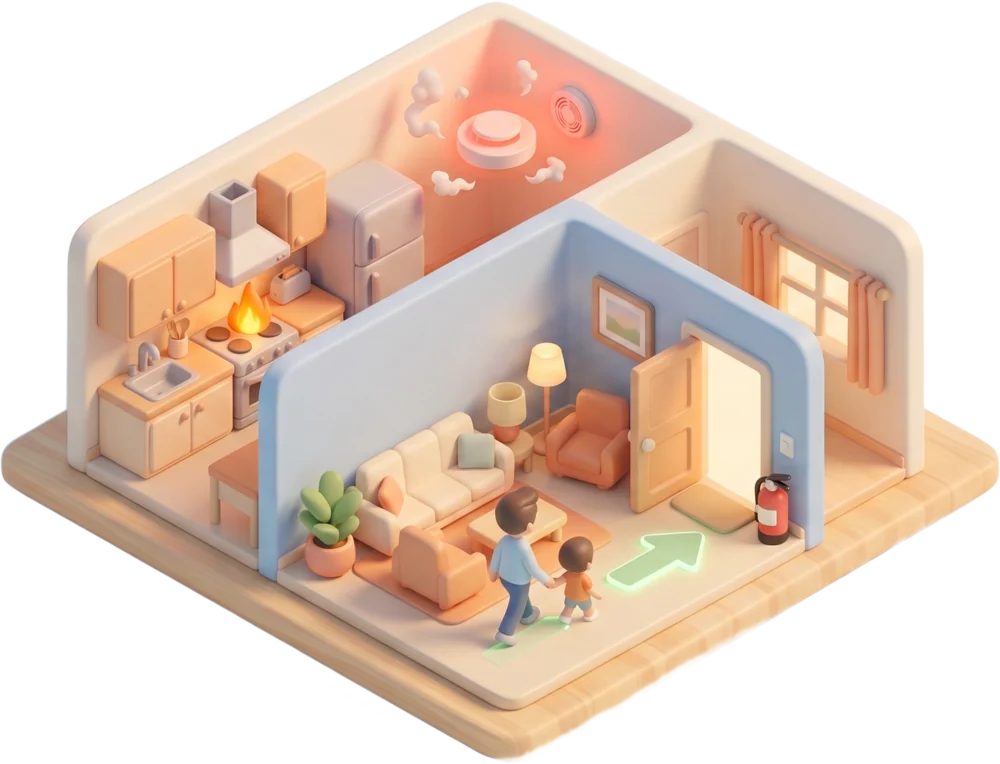
Working smoke alarms and a practised escape plan give you the seconds you need to get out alive.
Official maps and warning channels for Germany
Whether your street is affected is answered only by the official maps for your area.
Fire safety starts at home: test your smoke alarms and practise the escape route with everyone. Where wildfire is a threat, also follow local fire bans, fire-danger ratings and civil-protection maps.
Official maps
Open NINA (Germany)Most fire deaths happen at night from smoke and toxic gases, not from flames — and often within minutes. A home fire can fill a room with thick, blinding smoke faster than you can gather your things. The two things that save lives most reliably are working smoke alarms that wake you early, and a simple escape plan everyone in the home has practised. This guide covers home and building fire safety first, then a short section on wildfires that threaten homes. In any life-threatening fire, get everyone out, stay out, and call 112 — the EU-wide emergency number.
When it is happening
Only if this scenario is imminent or already underway — not everyday preparation. For prep ahead of time, see How to prepare and the checklist below.
If a fire starts in your home
- 1Warn everyone in the home by shouting.
- 2Get everyone out — do not stop to collect belongings.
- 3Stay low under the smoke, where the air is cleaner.
- 4Check closed doors with the back of your hand before opening – if the door is warm, keep it shut.
- 5If the stairwell is on fire, stay in the flat: close the door, seal the gaps with damp cloths, make yourself seen at the window and call 112.
- 6Close doors behind you as you leave to slow the fire and smoke.
- 7Once outside, call 112 and stay out — never go back in for anything or anyone.
If smoke or fire blocks your escape
- 1Keep the door closed and put clothing or towels along the gap at the bottom.
- 2Go to a room with a window, ideally toward the street.
- 3Open the window (break it only if it will not open) and call 112 — give your exact address and floor.
- 4Wave a bright cloth or use a light so firefighters can see you.
- 5Stay by the window at floor level and wait to be rescued.
If your clothes catch fire
- 1Do not run — this feeds the flames.
- 2STOP where you are.
- 3DROP to the ground.
- 4ROLL over and over to smother the flames, covering your face with your hands.
- 5Cool any burns with clean, cool (not ice-cold) running water for at least 20 minutes. For large burned areas or small children, cool briefly and cautiously and keep the person warm — hypothermia is a risk.
If a fire alarm sounds in a public building
- 1Leave immediately by the nearest marked exit.
- 2Do not use lifts — use the stairs.
- 3Do not stop to collect belongings.
- 4Follow staff or emergency instructions and go to the assembly point.
- 5Do not go back inside until told it is safe.
If a wildfire threatens your area
- 1Evacuate early when authorities advise — do not wait to see flames.
- 2Close all windows, doors and vents; turn off air conditioning that draws outside air.
- 3Move flammable outdoor items (furniture, gas bottles, firewood) away from the house if time allows.
- 4Wear long sleeves, long trousers, sturdy shoes and a mask if smoke is thick; take your grab bag, documents and pets.
- 5Drive with headlights on, windows closed; if trapped in a car, park in a clear area, close vents, lie on the floor and call 112.
- 6If trapped at home and cannot leave, stay away from outer walls, fill sinks and bathtubs with water, and call 112.
Important safety warnings
- Get out and stay out — never go back inside a burning building for people, pets, or belongings. Tell firefighters who or what is still inside.
- Never use lifts during a fire — always use the stairs.
- Never throw water on a hot oil or fat fire — it explodes into flames. Turn off the heat and cover the pan with a lid or fire blanket.
- Smoke and toxic gases kill faster than flames — stay low, and if you cannot escape safely, keep a door between you and the fire and call 112.
- Never disable, remove the battery from, or paint over a smoke alarm — a silent alarm cannot warn you.
- In a wildfire, do not wait to see flames before leaving — evacuate early when authorities advise; late escape by car through smoke is deadly.
How to prepare
Install and maintain smoke alarms
- 1Fit smoke alarms in every bedroom, in hallways, and on each floor.
- 2Test every alarm about once a month using the test button.
- 3Replace batteries when the alarm chirps a low-battery warning; consider 10-year sealed alarms.
- 4Replace smoke alarms about every 10 years.
- 5Do not fit smoke alarms in kitchens or bathrooms where steam causes false alarms — place them just outside.
Make and practise an escape plan
- 1Plan two ways out of every room, usually a door and a window.
- 2Agree one meeting point outside, such as a tree or a neighbour's gate.
- 3Practise the plan with everyone, including children, at least twice a year.
- 4Practise once in the dark, since most fatal fires happen at night.
- 5Make sure everyone can unlock doors and windows quickly; keep keys in a known place.
Reduce fire risks at home
- 1Never leave cooking, candles, or open flames unattended.
- 2Do not overload sockets or run cables under rugs.
- 3Keep matches, lighters, and heaters away from children and flammable items.
- 4Switch off and unplug electrical devices you are not using, and do not charge devices on beds or sofas.
- 5Keep escape routes and exits clear of clutter.
Be ready to respond
- 1Keep a fire blanket in the kitchen and learn how to use it.
- 2Consider a suitable fire extinguisher and know how to operate it.
- 3Save 112 in every phone and teach children how and when to call.
- 4Fit a carbon monoxide alarm if you have any fuel-burning appliance, fireplace, or attached garage.
- 5Know how to help anyone who needs assistance to evacuate, such as older or disabled household members.
Good to know
- 112 is the free emergency number across the whole EU, reachable from any phone, and connects you to fire, medical, and police help.
- Smoke, not flames, causes most fire deaths — it is thick, black, and toxic, and can leave you unconscious in a few breaths.
- Closing doors as you leave dramatically slows the spread of fire and smoke and can protect the rooms behind them.
- In Germany emergency warnings reach mobile phones via cell broadcast ("DE-Alert"); the free NINA warning app (from the BBK) and warning sirens add to it.
- A home fire can go from a small flame to filling a room with deadly smoke in just a couple of minutes — early warning and a fast exit matter more than fighting the fire.
- For wildfires near homes, clearing dry vegetation, leaves, and firewood away from the walls (defensible space) and closing windows and vents against flying embers greatly improves a home's chances.
Preparedness checklist
The concrete steps for this scenario. Add them to a plan to track your progress.
Actions
- Test smoke alarms monthlyEssential
Alarms fail quietly — dust, dead batteries and age are the usual culprits. Hold the test button once a month until the siren sounds, swap replaceable batteries about once a year, and replace the whole unit after roughly ten years, the typical sensor lifespan.
- Plan two ways out of every roomEssential
Thick smoke can block your usual door within minutes, so every room needs a second way out — often a window onto a balcony, garage roof or low ground floor. Walk your home room by room, agree both routes, and make sure everyone can open the window locks. Revisit the plan whenever the layout or household changes.
- Keep escape routes and exits clear of clutter
Escaping in blinding smoke happens by feel, and anything left in a hallway becomes a trip hazard exactly where you can least afford one. Keep corridors, stairs and doorways permanently free of boxes, shoes and bikes, leave a key by every lockable door on your route, and walk the route as a check every few months.
- Unplug unused devices and never charge on beds or sofas
Lithium batteries and cheap chargers can overheat and ignite, and bedding traps that heat until it does. Charge phones, tablets and e-bike batteries on a hard, non-flammable surface while you are awake nearby, unplug chargers and heat-producing appliances after use, and never daisy-chain power strips.
- Clear dry vegetation and firewood away from outside walls
Flying embers, not the fire front, ignite most homes in a wildfire — and they land in dry leaves, gutters and woodpiles against the wall. Before each dry season, remove dead vegetation within several metres of the house, clear the gutters, and move firewood and gas cylinders well away from the walls.
Supplies
- Fit smoke alarms on every floor and in bedroomsEssential
Smoke kills sleeping people before flames reach them, so early warning is the biggest life-saver. Choose alarms certified to EN 14604, mount them on the ceiling mid-room, and prefer sealed 10-year battery models. In Germany, bedrooms, children's rooms and hallways are legally required locations.
- Keep a fire blanket in the kitchen
Water on burning fat explodes into a fireball — turn off the heat and smother the flames with a fitting lid or fire blanket. Choose a blanket certified to the current standard EN 1869:2019 and mount it visibly near the kitchen exit, not above the cooker. Blankets are single-use: replace after use.
- Fit a carbon monoxide alarm near fuel-burning appliances
Carbon monoxide from a boiler, stove or fireplace is invisible and odourless, and smoke alarms cannot detect it — both are needed. Choose an EN 50291-1 certified unit, place it 1-3 m from each fuel-burning appliance at head height or 15 cm below the ceiling, and replace it by its end-of-life date, typically 7-10 years.
Skills
- Practise the escape plan twice a year, once in the darkEssential
A plan only works if your body knows it — walk the full route twice a year, once with the lights off, since most fatal fires happen at night. Crawl low where smoke would sit, close doors behind you and time the run; children who have rehearsed are far less likely to hide in a real fire.
- Learn stop, drop and roll
Running feeds burning clothes with air, so the flames must be smothered instead. Rehearse until it is automatic: stop where you are, drop down covering your face with your hands, and roll until the flames are out. Practise it with children as a game — under stress, people only do what they have done before.
Know & check
- Agree one outside meeting point for everyoneEssential
One fixed point tells you immediately whether anyone is still inside — the first thing firefighters will ask. Pick a spot everyone can name, such as a lamppost or a neighbour's gate, at a safe distance from the building, and agree that nobody ever goes back in for people, pets or belongings.
- Save 112 and teach children how to callEssential
112 reaches fire, medical and police help free of charge everywhere in the EU. Teach children to call it only once safely outside, to say their name and address slowly, and to stay on the line until told to hang up — practising the sentences aloud makes them stick under stress.
Official sources
- Federal Office of Civil Protection and Disaster Assistance (BBK) · BBK (Germany)
- EU Civil Protection & Humanitarian Aid · European Commission
- International Federation of Red Cross and Red Crescent Societies · IFRC
- World Health Organization · WHO
Official sources in Germany
Content last reviewed: September 4, 2026