Track this checklist in your personal plan.
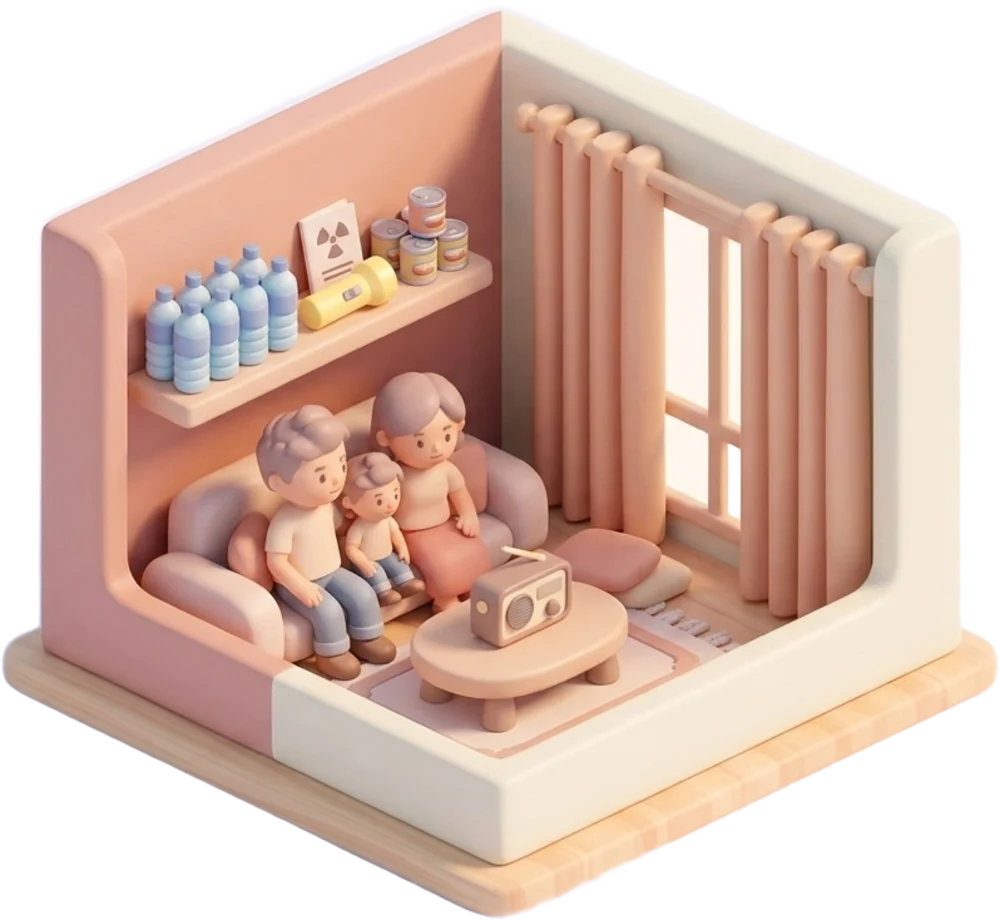
Nuclear / radiological event
Go in, stay in, tune in — shelter first; take iodine only if authorities tell you to.
Official maps and warning channels for Germany
Whether your street is affected is answered only by the official maps for your area.
Know Seveso / industrial sites and nuclear facilities near you and what local sirens mean.
Official maps
Open NINA (Germany)A nuclear or radiological emergency can mean a release of radioactive material from a plant, transport accident, or weapon. You cannot see or smell radiation. For the public, the protective actions are simple and the same almost everywhere in Europe: go indoors, stay indoors, close windows and ventilation, and follow official instructions on radio, TV and warning apps. Iodine tablets protect the thyroid from radioactive iodine only — and only when taken at the right time. Wrong self-medication can harm you. In Germany iodine tablets are not pre-distributed to households; the authorities hand them out in an emergency – swallow them only when they say so. In any life-threatening situation, call 112.
When it is happening
Only if this scenario is imminent or already underway — not everyday preparation. For prep ahead of time, see How to prepare and the checklist below.
If authorities warn of a radiological release
- 1Go indoors immediately — solid buildings shield better than cars or tents.
- 2Close all windows, doors and external vents; switch off air conditioning and mechanical ventilation that draws outside air.
- 3Stay in an inner room if possible, away from outer walls and the roof.
- 4Turn on radio, TV or your official warning app and listen for instructions.
- 5Do not leave to collect children from school unless authorities say so — schools shelter too.
- 6Call 112 only if someone is injured or in immediate danger; keep lines free for emergencies.
If you were outside during a release
- 1Remove outer clothing carefully before or just after entering; bag it and keep it away from others.
- 2Shower with lukewarm water and mild soap; do not scrub hard or use conditioner on hair (it can bind particles).
- 3Blow your nose, rinse eyes and mouth with clean water if available.
- 4Change into clean clothes stored indoors.
- 5Seek medical advice as authorities instruct — do not rush to hospitals unless you are injured.
About iodine tablets
- 1Take potassium iodide (iodine tablets) ONLY when public authorities tell you the dose and timing.
- 2Do not take them "just in case", as a daily supplement, or for non-radioactive hazards.
- 3They protect only the thyroid against radioactive iodine — not against other radiation or fallout particles.
- 4Follow age and pregnancy guidance on the package insert and official instructions.
Important safety warnings
- Never take iodine tablets on your own initiative — wrong timing or dose can be harmful, especially for some thyroid conditions.
- Do not go outside to "see what is happening" or to film; re-entering later is harder once contaminated.
- Do not evacuate unless authorities order it — traffic and open air can increase exposure.
- Pets: bring them indoors; wipe paws and fur carefully if they were outside.
How to prepare
Know the alerts and your building
- 1Install the official warning app NINA and enable cell broadcast ("DE-Alert" in Germany).
- 2Know how to close windows and shut off ventilation and air conditioning quickly.
- 3Identify an inner room for sheltering and keep a battery radio, torch and water there.
- 4Germany has had no operating nuclear power plant since April 2023; what matters are plants in neighbouring countries close to the border (e.g. Cattenom, Tihange/Doel, Temelín, the Swiss plants). If you live within about 100 km of one, learn the emergency plan of your Land and how iodine tablets would be distributed there.
Household kit for sheltering
- 1Drinking water, shelf-stable food and any regular medicines for at least 72 hours indoors.
- 2Battery or hand-crank radio, torch, spare batteries, power bank.
- 3Duct tape and plastic sheeting only if official guidance for your area recommends sealing gaps.
- 4Copies of documents and a written list of medications and contacts.
Good to know
- 112 is free in Germany and across the EU, works without credit and over any available network. Without a SIM card an emergency call is not possible in Germany – the card must be in the phone.
- Building materials and distance from outer walls reduce external radiation; time indoors matters.
- EU countries coordinate nuclear emergencies through national regulators and the EU Civil Protection Mechanism.
- After a release, food and water advice from authorities overrides normal shopping — follow boil-water or food bans exactly.
Preparedness checklist
The concrete steps for this scenario. Add them to a plan to track your progress.
Actions
- Install warning app + cell broadcast (DE-Alert)Essential
A radiological go-indoors order can arrive by phone alert, so check now that cell broadcast is enabled: on iOS at the bottom of Settings > Notifications, on Android under Safety & emergency. Add a national warning app as a second channel — in Germany NINA or KATWARN — and never rely on one channel alone.
- Choose an inner shelter roomEssential
Pick it in advance and show every household member: an interior room, cellar or spot in the middle of the building, with as many walls and floors as possible between you and outside — each layer of building mass cuts external radiation. Avoid rooms with large windows; masonry shields better than lightweight walls.
- Agree how family stays in touch during shelter-in-place
A release can catch household members at work or school, and the rule is to shelter where you are — not to drive home through the plume. Agree in advance that everyone stays put, texts instead of calling to spare congested networks, and checks in with one out-of-area contact; keep those numbers on paper too.
Supplies
- 72 h water and food for indoor shelteringEssential
Count on about 2 litres of water per person per day — 6 litres each for the EU's 72-hour baseline — plus no-cook food like canned goods, crispbread and UHT milk, and a manual can opener. Sealed bottled water is safest, as tap water may be restricted after a release; official German guidance suggests ideally ten days.
- Battery / hand-crank radioEssential
While you shelter indoors, the all-clear and any iodine instructions come over broadcast radio even if mobile networks are congested or down. Choose a set with a dual FM and DAB+ tuner, battery-powered with a crank or solar backup if possible, and keep spare batteries outside the device so leaking cells cannot ruin it.
Know & check
- Know how to shut windows and ventilationEssential
Sheltering only works while outside air stays outside, because radioactive particles ride in on the air your ventilation draws in. Locate the switches for mechanical ventilation and air conditioning now, and note which windows, trickle vents and extractor hoods need closing — under stress there is no time to search.
- Know local iodine rules — take only if orderedEssential
High-dose potassium iodide tablets protect only the thyroid, and only if timed right — swallow them only when authorities order it. In Germany the tablets are handed out by the authorities in an emergency, not in advance: to adults up to 45 within about 100 km of a plant, and to children, adolescents and pregnant women nationwide. Over about 45, taking them is advised against.
- Document copies and med list ready
Should evacuation be ordered after the sheltering phase, you will leave fast — so keep copies of IDs, insurance policies and key certificates in one grab-ready folder, with a written list of everyone's medicines and doses. Store duplicates outside the home and as encrypted digital copies on a USB stick or in the cloud.
Official sources
- BBK — radiation protection / nuclear accidents · BBK (Germany)
- Iodine blockade – questions and answers · Bundesamt für Strahlenschutz (BfS)
- IAEA public protective actions · IAEA
- EU Civil Protection · European Commission
Official sources in Germany
Content last reviewed: September 4, 2026